
The top mistake amateur players make
+ best chess books I read in 2025Recently I was a guest on an episode of Ben Johnson‘s Perpetual Chess Podcast, and he asked me this question:
‘What are common mistakes amateur players make?’
I gave him three. Here I’ll flesh out the first one because it’s a mistake that can sabotage all your hard work.
Mistake #1: Not playing enough tournament games
If you want to get better at OTB (over-the-board, in-person games), nothing comes close to playing OTB.
No amount of study can recreate the feeling of sitting there with the clock ticking, knowing the fate of the game depends on your next move. That’s what all your training is for and where your blind spots cost you points.
Books, puzzles and videos help. But if you don’t connect them to real games, your understanding stays abstract. It’s like learning to kick a ball from a textbook.
OTB games level you up for two reasons:
1\. They’re serious
Sitting across from someone for hours is a different kind of pressure. Your real habits appear, and the quality of play is higher because you and your opponent really want to beat each other. Guessing and wishful thinking get punished.
This is the part most online-only players underestimate. Online can feel like practice while OTB feels like a stage.
Even if you only play online, you can raise the stakes:
- play training matches with friends
- compete regularly in online tournaments
- decide one platform is for serious games, set a number of games for the day or session, analyse every loss and find some takeaways.
My own improvement was built on playing many serious games.
I wasn’t “talented” at first. Even three years after learning how to play, my national rating was only 600. But I loved chess, I kept playing and studying every day and around Year 5 things started to compound. I became one of the top players for my age in Australia.
It took nearly 15 years from my first tournament until I achieved the IM title at age 22. In that time, I played over 1,000 classical tournament games.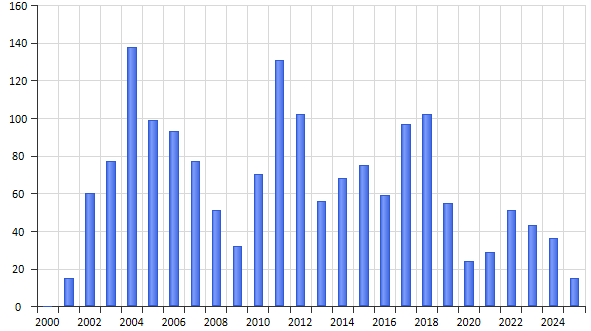
Number of OTB classical games I played, by year, 2001–2025. Total: around 1,700
One serious OTB game played with full focus can teach you more than a dozen distracted rapid games because there’s nowhere to hide under those stage lights.
If you’ve never played OTB, start at a local club before you jump into a big event. The first few games will feel awkward: moving the pieces with your hand, the board looks different from a screen and you have to write down the moves. But at some point, you’re totally immersed in the silence and 64 squares in front of you.
And at once the vicissitudes of life had become indifferent to me, its disasters innocuous, its brevity illusory - this new sensation having had the effect, which love has, of filling me with a precious essence; or rather this essence was not in me, it was me. I had ceased now to feel mediocre, contingent, mortal. Whence could it have come to me, this all-powerful joy?
—Marcel Proust, Swann’s Way (In Search of Lost Time #1)
Serious games are mirrors. They reflect your habits, attention and who you are now.
2\. They’re long
You realise at some point that improvement isn’t about what you know, but how long you can stay focused enough to use what you know.
Longer time controls allow you to
- think deeply,
- think about when to think,
- reach the endgame with time on the clock and
- build concentration, which theory alone can’t teach.
Playing serious, longer games, as often as possible is the multiplier that increases your level over time: Quality x Quantity.
It’s also why chess powerhouses produce so many strong players. It’s not just talent but the system of clubs, leagues, coaches and classical OTB as a weekly habit.
If you’re just starting, jumping straight into 90-minute games can feel like reading Proust in kindergarten. Try rapid first, something like 15 minutes + 10 seconds per move. Having increment reduces losses on time and forces you to keep playing the game even when you’re worse.
When your foundations are built on classical and rapid, blitz becomes more fun too. You bring depth into faster formats instead of letting blitz habits seep into your longer games.
If you want to improve OTB in 2026, play as many serious and long games as you can.
My best chess books of 2025
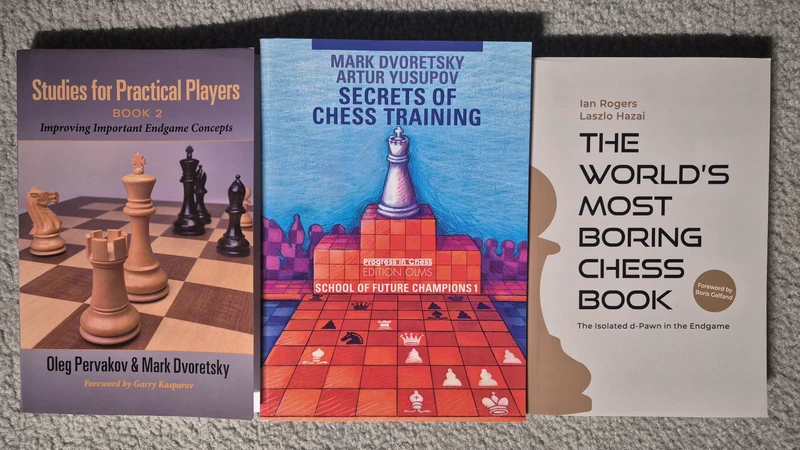
Secrets of Chess Training (Dvoretsky & Yusupov)
I’ve been reading each of the 5-book series and all are great but this first volume was my favourite. Highly recommended for serious players who want to know the methods D & Y used to transform countless students into grandmasters and masters (assessing own strengths and weaknesses, analysing games and learning from classics).
Studies for Practical Players Book 2 (Pervakov & Dvoretsky)
If you’re FIDE 2000+ and aiming for higher, Book 1 is amazing for training your calculation and creativity through immersing yourself in endgame studies. I’d go for that one first but Book 2 is also a gem full of breathtakingly beautiful studies.
The World’s Most Boring Chess Book (Rogers & Hazai)
A charming title for a book covering the niche topic of... IQPs in endgames! For those who already have some understanding of pawn structures and want to go deeper.
You may also like
 Lichess
Lichess: End of Year Update 2025
Is it just us, or has this year flown by? As we say goodbye to 2025 and enter 2026, let's look back … IM datajunkie
25 lessons from 25 years of chess
Mistakes you can avoid and habits you can start with today IM datajunkie
Do this on your opponent's turn
5 simple habits to use your time better and level up your chess ChessMonitor_Stats
Where do Grandmasters play Chess? - Lichess vs. Chess.com
This is the first large-scale analysis of Grandmaster activity across Chess.com and Lichess from 200… CM HGabor
How titled players lie to you
This post is a word of warning for the average club player. As the chess world is becoming increasin… IM datajunkie